Even the Celebrities Wanted to Dress Rather Appropriately standout looks or moments from this week

Even the Celebrities Wanted to Dress Rather Appropriately standout looks or moments from this week

Certainly! Here are some standout looks or moments from celebrities this week that have caught attention for their appropriateness and style:

Red Carpet Glamour:

At a recent awards ceremony, several celebrities opted for elegant and sophisticated looks that balanced style with appropriateness. For example, a prominent actress wore a stunning floor-length gown in a classic silhouette, adorned with intricate beadwork and complemented by minimalistic jewelry, presenting a timeless and tasteful appearance.

Chic Daytime Ensemble:

Another celebrity was spotted in a chic daytime ensemble during a casual outing. She chose a tailored blazer paired with high-waisted trousers, accessorizing with sleek sunglasses and a structured handbag. The outfit was both polished and appropriate for various settings, showcasing effortless sophistication.

Fashion-forward Event Appearance:

At a charity event, a singer-songwriter made a statement in a fashion-forward yet appropriate outfit. She wore a contemporary midi dress with asymmetrical detailing, accessorized with bold earrings and elegant heels. The ensemble struck a balance between modernity and elegance, making a memorable impression.

Casual Yet Stylish Outfit:

A well-known actor was photographed in a casual yet stylish outfit while attending a promotional event. He opted for a tailored shirt paired with dark denim jeans and accessorized with a leather belt and classic sneakers. The ensemble was effortlessly cool and suitable for the occasion, reflecting his personal style with understated sophistication.

Effortless Evening Look:

A model turned heads with an effortless evening look at a film premiere. She chose a draped silk gown in a soft pastel shade, accessorizing minimally with delicate jewelry and strappy heels. The outfit showcased a blend of grace and simplicity, demonstrating a keen sense of appropriateness and elegance.

These moments highlight how celebrities can inspire with their fashion choices, balancing style with appropriateness for various occasions, from red carpet events to casual outings and charity galas. Each look embodies a unique blend of trends, personal style, and sophistication, setting trends and making a lasting impression in the fashion world.


8 secrets of the French way of life: stay slim, live well.

8 secrets of the French way of life: stay slim, live well.

The French way of life is often admired for its emphasis on enjoying good food, maintaining a balanced lifestyle, and staying slim without strict diets. Here are 8 secrets that contribute to their approach to staying slim and living well:

Portion Control:

French cuisine emphasizes quality over quantity. Meals are typically served in smaller portions, allowing for enjoyment without overeating. This practice helps in maintaining a healthy weight.

Fresh, Whole Foods:

French meals often feature fresh, seasonal ingredients and whole foods such as fruits, vegetables, lean proteins (like fish and poultry), and whole grains. These provide essential nutrients while keeping calorie intake in check.

Daily Physical Activity:

Walking is a common form of exercise in France. Whether it’s walking to work, running errands on foot, or enjoying leisurely strolls, integrating daily physical activity into their routine helps the French stay active and burn calories.

Mindful Eating:

Meals in France are often enjoyed slowly and savored. This practice of mindful eating allows individuals to listen to their body’s hunger and fullness cues, preventing overeating and promoting satisfaction.

Limited Snacking:

Unlike in some cultures, snacking between meals is less common in France. The focus is on enjoying three balanced meals a day, which helps in maintaining stable energy levels and controlling weight.

Cultural Appreciation of Food:

Food is deeply rooted in French culture, with an emphasis on quality, taste, and pleasure. Enjoying meals with family and friends, and taking time to appreciate the flavors and textures, contributes to a positive relationship with food.

Moderate Alcohol Consumption:

Wine is often consumed in moderation with meals in France. Red wine, in particular, is rich in antioxidants and can have health benefits when consumed in appropriate amounts.

Work-Life Balance:

The French prioritize leisure time, family, and enjoying life outside of work. This balanced approach to life helps reduce stress levels, which can contribute to better overall health and well-being.

By adopting some of these principles—such as portion control, mindful eating, regular physical activity, and enjoying food with others—you can incorporate elements of the French way of life into your own routine to stay slim and live well. It’s about finding a balance that promotes both physical health and enjoyment of life’s pleasures.

Summer is coming. Have you ever considered going solo? Travel

Summer is coming. Have you ever considered going solo? Travel

Summer is indeed a great time for solo travel! Whether you’re exploring new places, reconnecting with yourself, or simply seeking adventure, solo travel can be a rewarding experience. Here are some reasons why solo travel might be worth considering:

Personal Growth:

Solo travel pushes you out of your comfort zone, encouraging personal growth and self-discovery. You learn to rely on yourself, make decisions independently, and adapt to new situations.

Freedom and Flexibility:

You have the freedom to choose your own itinerary, pace, and activities without compromising with others. This flexibility allows you to fully immerse yourself in experiences that interest you the most.

Meeting New People:

Solo travel often encourages interactions with locals and other travelers. It’s easier to strike up conversations and form meaningful connections when you’re on your own, leading to memorable encounters and friendships.

Self-Reflection and Relaxation:

It’s a chance to disconnect from daily routines, reflect on life, and recharge. Whether you prefer exploring bustling cities or relaxing on serene beaches, solo travel allows you to set your own agenda for relaxation and rejuvenation.

Empowerment and Independence:

Successfully navigating a new destination on your own boosts your confidence and independence. You gain a sense of empowerment as you overcome challenges and navigate unfamiliar environments.

Tailored Experiences:

You can tailor your travel experiences to suit your interests, whether it’s culinary adventures, cultural exploration, outdoor activities, or historical discoveries. Solo travel allows you to prioritize what matters most to you.

Spontaneity:

Without having to coordinate with others, you’re free to be spontaneous and seize opportunities as they arise. Whether it’s a last-minute excursion or a change in plans, solo travel allows you to embrace unexpected adventures.

Self-Care:

It’s an opportunity to prioritize your own needs and well-being. You can indulge in self-care activities, such as meditation, yoga, or simply enjoying peaceful moments in nature, without distractions.

If you’re considering solo travel this summer, start by researching destinations that appeal to you, plan your itinerary based on your interests, and take steps to ensure your safety and comfort. Embrace the freedom and adventure that solo travel offers, and you may discover a new sense of empowerment and fulfillment along the way!

The First Step to Success

The First Step to Success

The first step to success can vary depending on individual goals and circumstances, but here are some universal principles that often mark the beginning of a successful journey:

Clarity of Purpose:

Define your goals and aspirations clearly. Whether it’s starting a business, advancing in your career, improving your health, or pursuing a personal passion, having a clear vision of what success means to you sets the foundation for your journey.

Commitment and Dedication:

Success often requires dedication and persistence. Commit to taking consistent action towards your goals, even when faced with challenges or setbacks. Stay motivated by reminding yourself of the reasons behind your pursuit.

Continuous Learning:

Invest in acquiring knowledge and skills relevant to your goals. Seek opportunities for growth, whether through formal education, mentorship, self-study, or practical experience. Embrace a mindset of lifelong learning and adaptation.

Effective Planning and Organization:

Develop a plan of action that outlines specific steps and milestones towards achieving your goals. Break down larger objectives into smaller, manageable tasks to maintain clarity and momentum.

Courage to Take Risks:

Success often involves stepping outside your comfort zone and taking calculated risks. Be willing to embrace uncertainty, learn from failures, and see challenges as opportunities for growth and innovation.

Resilience and Adaptability:

Stay resilient in the face of obstacles or setbacks. Adapt to changing circumstances, adjust your strategies when necessary, and maintain a positive attitude towards overcoming challenges.

Building Support Networks:

Surround yourself with supportive individuals who believe in your abilities and aspirations. Seek guidance from mentors, collaborate with like-minded peers, and leverage your network for advice, opportunities, and encouragement.

Action and Execution:

Ultimately, success is achieved through action. Take that first step towards your goals with determination and confidence. Each action you take brings you closer to realizing your vision of success.

Remember, the first step may be daunting, but it signifies your readiness to embark on a journey towards achieving your dreams. Embrace the process, stay focused on your goals, and celebrate each milestone along the way.

What is a Marubozu candlestick? How to trade them?

What is a Marubozu candlestick? In this blog we learn about Marubozu candles and the psychology behind trading the pattern.

In technical analysis of the stock market, traders look for patterns in the price and volume of securities to make predictions about future price movements. One such pattern is the marubozu, which is a single candle on a candlestick chart that has no shadow or wick on one end, signifying strong buying or selling pressure.

A bullish marubozu is a candlestick that has a long green body with no upper wick, indicating that buying pressure was strong throughout the trading session, pushing the price up from the open to the close. This pattern is usually seen as a strong bullish signal and traders may interpret this as a bullish trend reversal or a continuation of an existing bullish trend.

When a bullish marubozu forms, traders interpret it as a sign of strong buying pressure and confidence in the market. This may lead to increased optimism and a sense of security among traders, leading them to take long positions in the stock. The bullish sentiment may also lead to increased demand and further price appreciation, thus continuing the positive cycle.

What is a Marubozu
First and Second green candles are Bullish Marubozu while fourth candle (Red) is an example of bearish Marubozu.

On the other hand, a bearish marubozu is a candlestick that has a long black body with no lower shadow, indicating that selling pressure was strong throughout the trading session, pushing the price down from the open to the close. This pattern is usually seen as a strong bearish signal and traders may interpret this as a bearish trend reversal or a continuation of an existing bearish trend.

When a bearish marubozu forms, traders interpret it as a sign of strong selling pressure and bearish sentiment in the market. This may lead to increased fear and caution among traders, leading them to take short positions or exit long positions in the stock. The bearish sentiment may also lead to decreased demand and further price depreciation, further worsening the selling pressure.

It is important to note that market psychology is not always rational and can be influenced by various factors, such as news events, economic data releases, and rumors. Therefore, traders should not solely rely on candlestick patterns and should always consider multiple factors before making a trading decision.

The other common single candlestick patterns are Bullish Engulfing, Bearish Engulfing, and Inverted Hammer. Please click on respective links to access the blog.

What are Doji and Spinning top candlestick patterns?

What are Doji and Spinning top candlestick patterns? In this blog, we will look into two very important candle patterns.

Doji and spinning top candles are two important candlestick patterns that traders use to interpret market sentiment and make informed trading decisions. In this article, we’ll discuss what doji and spinning top candles are, how they are formed, and how traders use them to make trading decisions.

What is a Doji Candle?

A doji candle is a candlestick pattern that signals indecision in the market. It is formed when the opening and closing price of a security is almost the same, resulting in a candle with long wicks on both the upper and lower end. The long wicks show that both buyers and sellers have attempted to push the price in opposite directions, but neither side was able to gain control. This results in a candle with a small real body that is often situated near the middle of the candle’s high and low range.

What is a Spinning Top Candle?

A spinning top candle is a similar pattern to the doji candle, but it is formed when the real body of the candle is larger and the upper and lower wicks are still relatively long. The spinning top candle also signals indecision in the market, as the larger real body shows that both buyers and sellers have taken control of the price at some point during the trading session, but neither side was able to gain a sustained advantage.

How to Use Doji and Spinning Top Candles in Trading

Doji and spinning top candles are most effective when used in conjunction with other technical analysis tools, such as trend lines, support and resistance levels, and moving averages. Traders often look for doji and spinning top candles at key levels of support and resistance, as they can signal a potential reversal in the trend.

Doji Spinning top
Doji and Spinning top candles
In the pic above, the first green candle is close to what doji would look like. The third red candle which has a thicker body is close to what a spinning top would look like.

For example, if a doji or spinning top candle forms at a key resistance level, it may indicate that the price has reached a top and that a downward trend could soon follow. On the other hand, if a doji or spinning top candle forms at a key support level, it may indicate that the price has reached a bottom and that an upward trend could soon follow.

The other common single candlestick patterns are Marubozu and Inverted Hammer. Please click on respective links to access the blog.

What is a candlestick pattern? How to read them?

What is a candlestick?

A candlestick is a type of chart that is commonly used in technical analysis to display the price movements of a financial instrument, such as a stock, currency, or commodity, over a specific period of time. Each candlestick is represented by a “real body” which displays the open and close prices and “tails/wicks”, which display the highest and lowest prices reached during the period.

What is a Candlestick?
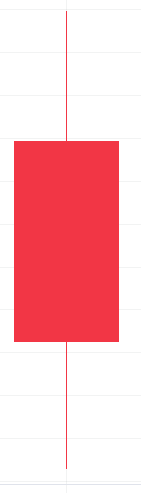
A bearish Candlestick

The red rectangular part as seen in the image above is called body and the thin line on top and bottom of body is called tail/wick/shadow.

In a candlestick pattern, the body represents the area between the open and close prices of a financial instrument during a specific period of time. The body is typically shown as a rectangle and its color can indicate the direction of price movement. A white or green body indicates that the closing price was higher than the opening price, indicating a bullish movement, while a black or red body indicates that the closing price was lower than the opening price, indicating a bearish movement.

The tail/wick is the line above or below the body that represents the high or low price for the period. A tail above the body is called an upper tail or upper wick, and it represents the highest price reached during the period. A tail below the body is called a lower tail or lower shadow, and it represents the lowest price reached during the period.

In a candlestick chart, the upper and lower tails can provide insight into market sentiment. For example, a long upper tail on a candle can indicate that bears (sellers) tried to push the price down and were ultimately successful, indicating that bulls (buyers) lost the grip. Similarly, a long lower tail on a candle can indicate that bears(sellers) tried to push the price down but were ultimately unsuccessful, indicating that bulls (buyers) tightened the control.

It’s worth noting that the length and position of the tails can provide additional information about the market sentiment and can be used to identify potential buying and selling opportunities.

In other blogs we will look into most common single candlestick patterns like Hammer and Shooting star, Marubozu, spinning top, Doji and Hanging Man.

What are Single candlestick patterns? How to trade them?

What are single candlestick patterns? How to trade them?

Single candlestick patterns are a popular tool used in technical analysis to predict future price movements in financial markets. These patterns are formed by a single candlestick and can provide insight into the sentiment of market participants.

There are several single candlestick patterns that are commonly used in technical analysis: We will look into hammer and shooting star in this blog.

Hammer

One of the most well-known single candlestick patterns is the “hammer” pattern. This pattern forms when the market opens at a high price, falls during the trading session, and then closes near the opening price. The long lower tail of the candlestick indicates that bears (sellers) were pushing prices down during the session, but bulls (buyers) ultimately stepped in to bring prices back up. The hammer pattern is considered a bullish reversal pattern, indicating that a downtrend may be coming to an end and that prices are likely to rise in the future.

Single candlestick patterns
Hammer candle formation after a downmove. Stock starts rallying after hammer formation

Shooting Star

Other popular single candlestick pattern is the “shooting star” pattern. This pattern forms when the market opens at a low price, rises during the trading session, and then closes near the opening price. The long upper tail of the candlestick indicates that bulls (buyers) were pushing prices up during the session, but bears (sellers) ultimately stepped in to bring prices back down. The shooting star pattern is considered a bearish reversal pattern, indicating that an uptrend may be coming to an end and that prices are likely to fall in the future.

Single candlestick pattern
A shooting star is formed after market rally. Stock starts down move after forming shooting star

It’s important to remember that these patterns should be used in conjunction with other forms of technical analysis and fundamental analysis to make more accurate predictions. Also, it’s important to look for confirmation of these patterns through the formation of other patterns or indicators.

In other blogs we will look into most common single candlestick patterns like Hammer and Shooting star, Marubozu, spinning top, Doji and Hanging Man.

Descending Triangle – How to Trade?

In this blog, we will talk about Descending triangle – How to trade it?

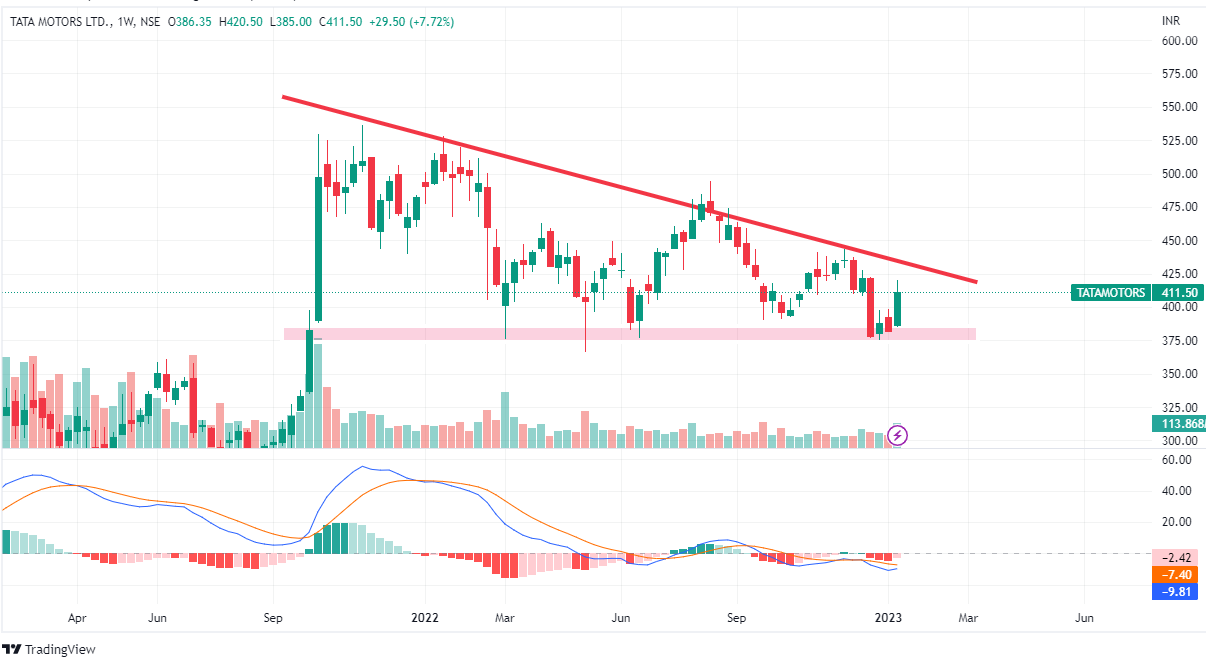
A descending triangle is a bearish chart pattern that is formed when the price of an asset creates a series of lower highs and a flat support line. This pattern is typically seen as a sign that the asset’s price is likely to decrease.

The descending triangle pattern is formed by two trendlines. The first trendline is a horizontal support line that connects the lows of the asset’s price and it can be an area of support too instead of the trendline. The second trendline is a downward-sloping line that connects the highs of the asset’s price. As the price of the asset approaches the support line or support area, it is unable to break through and instead bounces off, creating lower highs.

One of the key characteristics of a descending triangle is the decrease in volume as the pattern forms. We can see that in the chart of Tata motors, the volume has nearly died off. This decrease in volume is a sign that there is a lack of buying pressure and that the bears are in control.

Descending Triangle Pattern – Tata motors

It is often considered a bearish pattern and it is believed that the price of the asset will eventually break through the support line, leading to a significant price decline.

Traders often use the descending triangle pattern as a signal to enter a short position. It is important to note that the descending triangle pattern is not always accurate and it should be used in conjunction with other technical analysis tools to confirm the price direction.

How to trade Ascending triangle Pattern?

Ascending triangle is by far the most reliable pattern, out of multiple continuation patterns. In this blog, we will learn to identify an Ascending triangle pattern, and will also try to learn How to trade Ascending triangle Pattern. Let us understand the pattern in brief. Lets learn How to trade Ascending triangle Pattern.

An ascending triangle is formed when the price is restricted between an upward sloping trendline (support) and a horizontal trendline or area (resistance).

Look at the picture below.

How to trade Ascending triangle Pattern
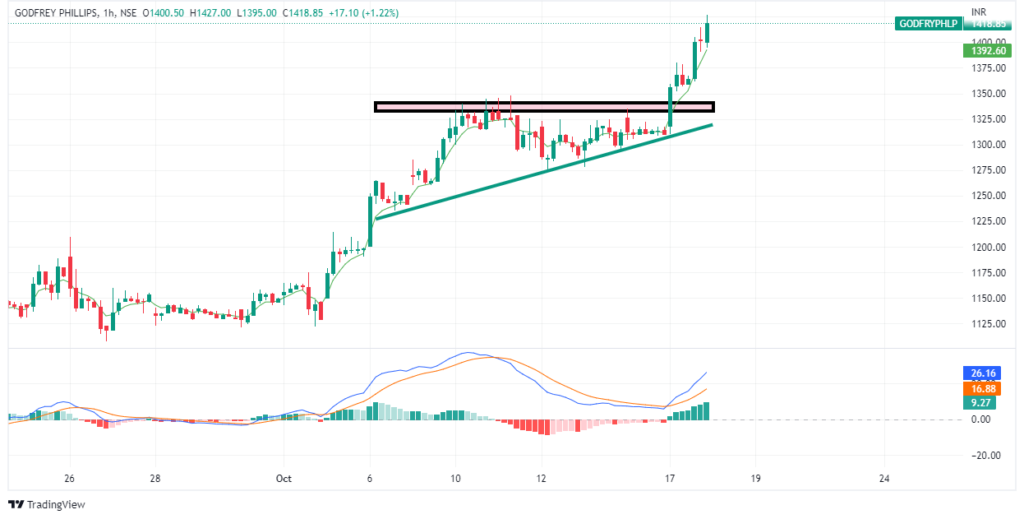
Godfrey Phillips – Ascending Triangle Breakout

The green trendline is upward sloping trendline and it acts as support. The price bounced up several times from this trendline and is demand zone.

The Rectangular highlighted area in the chart acts as resistance or the supply zone. Price tried to cross this area several times, but it had to face rejections.

As the upward sloping trendline(support) comes closer to Rectangular area (Resistance), we are nearing a possible indecision zone. Whenever support and Resistance zone converge, the probability of breakout increases.

Since Ascending triangle is a continuation pattern, the price keeps moving in the same direction as before the formation of Ascending triangle. The patten might not always give decent breakout, but we can combine Ascending triangle with other indicators like Volume, MACD, RSI to improve the win probability.

Depending on the risk appetite, stoploss can be placed either below upward sloping trendline or below the breakout Candle.

We should stick to buy trades after breakout on the higher side. This will improve our win probability, as the momentum before the breakout was on the same direction. Always trade in the direction of momentum, and you will end up on winning side in longer run.